 © Ritter Solartechnik GmbH & Co. KG
Solar Thermal Energy for District Heating Networks
Solar Heat for Leipzig: Research Advances Integration into the District Heating Network
Germany's largest solar thermal plant has been officially inaugurated in Leipzig. It demonstrates how solar heat can become an integral part of municipal district heating systems at scale. The project builds on more than a decade of applied energy research. Projects funded by the German Federal Ministry for Economic Affairs and Energy (BMWE) have improved yield forecasting, developed solar collectors specifically for district heating networks, tested advanced control systems, prepared manufacturing processes and investigated long-term operation.
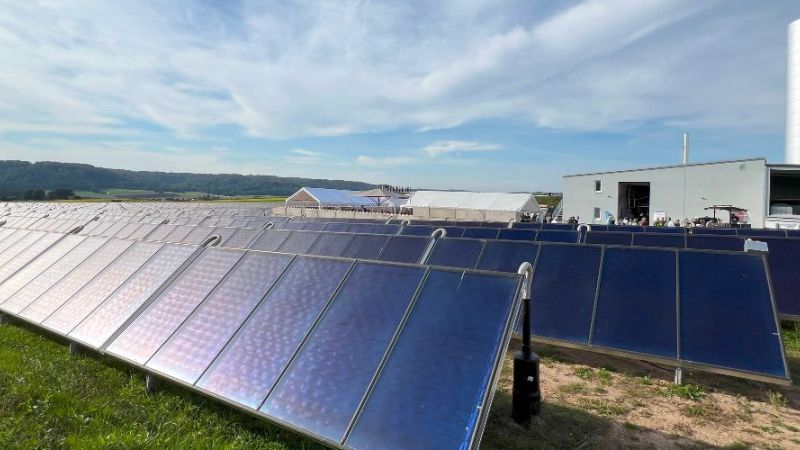
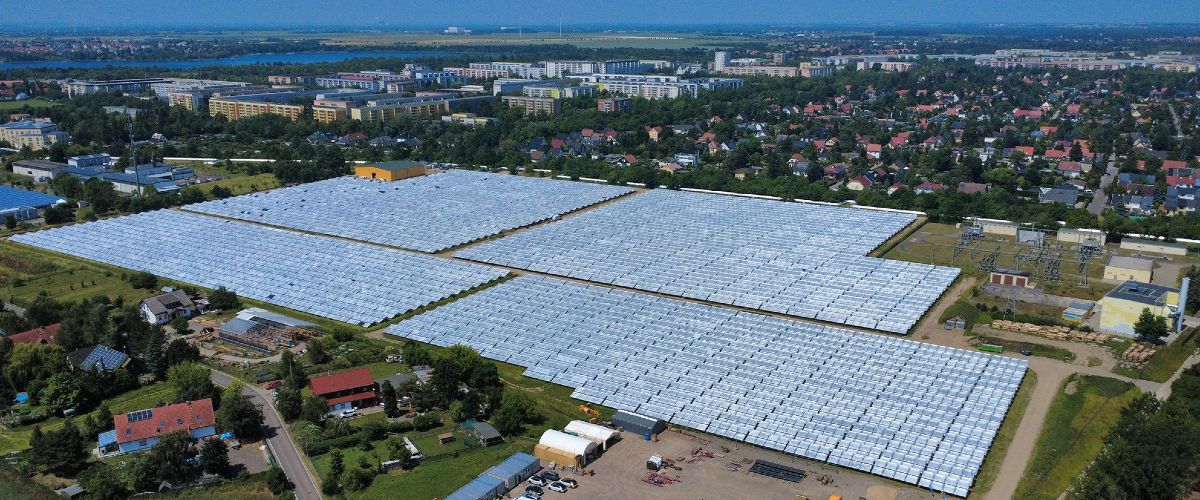
The plant is located in Leipzig-Lausen, a district in the west of Leipzig in the eastern German state of Saxony. More than 13,000 evacuated tube collectors have been installed there in long rows. Each glass tube contains reflective elements that concentrate solar radiation to generate heat. The facility is expected to produce around 26 gigawatt-hours (GWh) of heat each year, enabling solar thermal energy to supply part of Leipzig's district heating network, particularly during the sunnier months.
The project marks an important step in the transition to climate-friendly heating. It demonstrates that solar thermal technology can supply not only individual buildings but also large district heating networks. Making this possible is one of the key objectives of applied energy research: developing technologies that are reliable, controllable, durable and economically viable under real operating conditions.
Solar Thermal Energy for District Heating: Why Leipzig Matters
 © Ritter Solartechnik GmbH & Co. KG
Before construction begins on a large solar thermal field, planners need to know how much heat it will generate under real operating conditions. Reliable performance forecasts are essential for municipal utilities, investors and engineering consultancies.
This was precisely the focus of the ScenoCalc research project. As the project highlights, robust forecasts are critical because the design and operation of a solar thermal plant can determine whether additional usable heat is generated or energy is lost.
To address this challenge, the researchers developed ScenoCalc District Heating, a free Excel-based modelling tool for large-scale solar thermal systems connected to district heating networks. It is available for download at scfw.de. In large district heating systems, it is not enough to estimate the performance of individual collectors alone. Pipework, heat exchangers, thermal storage, network temperatures, heat demand profiles and weather conditions all interact to determine overall system performance.
"For large-scale solar thermal plants, reliable yield forecasts are fundamental to building confidence and providing investment certainty from the outset. ScenoCalc District Heating provides a tool that makes planning more transparent and enables meaningful comparisons between different system designs."Dominik Bestenlehner, Head of Research and Development at Ritter Solartechnik
CPC Evacuated Tube Collectors for Municipal Heat Supply
A solar thermal field supplying a district heating network operates very differently from a rooftop solar thermal system. It must deliver much larger quantities of heat, cope with higher network temperatures and integrate large numbers of collectors into a single, efficiently connected system. As a result, performance depends not only on heat output but also on installation, pipework, hydraulics and long-term operation.
These were the challenges addressed by the CPC Evacuated Tube Collectors for Large-Scale Solar Thermal Systems research project. The researchers developed high-performance collectors specifically designed for reliable and cost-effective use in district heating networks and other large-scale applications.
CPC stands for Compound Parabolic Concentrator. Reflectors direct solar radiation onto evacuated tubes, where water is heated as the heat transfer medium. This design remains highly efficient even at higher operating temperatures. That is particularly important for district heating networks, where solar thermal energy must not only maximise heat output but also match the temperature requirements of the network. At a district heating operating temperature of 75°C, the CPC evacuated tube collector achieves a standardised gross heat yield of more than 600 kilowatt-hours per square metre.
The research project therefore examined the entire collector field, including the hydraulic system, mounting structures, pipework, collector configurations, and performance and yield testing. Rather than focusing on the performance of individual collectors, the researchers investigated how large numbers of collectors work together as an efficient solar thermal heat generation system. Their findings provide the basis for plants that can deliver high heat yields while remaining practical to construct, integrate and operate.
"High collector yields are only part of the equation. For large-scale solar thermal plants, economic viability also depends on getting the construction right – from installation and pipework to hydraulic integration and long-term operation."Jan Neyrinck, Project Team Lead at Ritter Solartechnik
Preparing Large-Scale Solar Thermal Technology for Serial Production: A New Collector Design
For solar thermal plants to be deployed on a large scale, their components must not only perform reliably but also be suitable for efficient serial production. The HYDRA-RoS research project therefore focused on a key component of evacuated tube collectors: the absorber tube assembly.
In conventional collectors, several pipe runs are connected by header pipes. While this is an established design, it requires additional manufacturing steps and can affect how evenly the heat transfer fluid flows through the collector field. HYDRA-RoS took a different approach by developing an absorber tube assembly without header pipes. Instead, the complex serpentine pipework is brought together at a single circular connection, known as a drum connection. This alternative design changes the way the heat transfer fluid circulates through the collector while also making the component better suited to serial production.
Turning this concept into a practical solution required several stages of development. The project combined flow simulations, tube-bending techniques, joining processes, a demonstration plant, quality assurance, and both laboratory and field testing. At the outdoor test facility, collectors, sensors and actuators successfully completed 41 deliberately induced stress-test cycles. The result is a collector design that combines hydraulic advantages with a clear pathway towards serial production.
“HYDRA-RoS focused on one key question: how can a hydraulically optimised collector design actually be manufactured? It is only by combining simulation, tube-bending technology, joining techniques and quality assurance that an idea can be turned into a solution suitable for industrial production.”Dominik Bestenlehner, R&D Manager at Ritter Solartechnik
Integrating Solar Heat into Large District Heating Networks
As with the CPC Evacuated Tube Collector project, the scale of the solar thermal system was also a key focus of the SPSFW project. As solar thermal plants become larger, controlling and regulating their operation becomes increasingly complex. Large collector fields must respond to changing levels of solar irradiation, fluctuating outdoor temperatures and varying operating conditions across the district heating network. At the same time, they must feed heat into the network as it is generated while maintaining safe and reliable operation.
This was the focus of the SPSFW (Programmable Logic Control for Solar-Assisted District Heating) research project. The control routines developed by the researchers continuously adjusted plant operation in response to solar heat generation, network temperatures and heat demand. At the field test facility of the Chair of Building Energy Systems and Heat Supply at TU Dresden, the team achieved stable heat injection into the district heating network at 90°C. Throughout the tests, the temperature varied by only around 3 K, demonstrating the temperature stability required for operation at district heating temperatures.
This is an important milestone for municipal utilities. Within district heating networks, solar thermal energy complements existing heat generation technologies by supplying both thermal storage systems and consumers. To make a meaningful contribution, however, it must be fully integrated into the operation of the wider heat supply system.
"It is not just the amount of heat a solar thermal field generates that matters. Equally important is when that heat is fed into the network and at what temperature. Advanced control systems turn variable solar heat into a reliable, predictable source of district heating."Dr Rolf Meißner, Project Lead at Ritter Solartechnik
Renewable Heat Supply: The Contribution of Research
The Leipzig solar thermal plant is not a research facility. It does, however, demonstrate what can be achieved when research findings are developed further across multiple projects and taken up by industry, planners and energy suppliers. The plant received funding through Germany's Federal Funding for Efficient Heating Networks programme ( Bundesförderung für effiziente Wärmenetze). The technical foundations, however, were laid by a series of BMWE-funded research projects that have made large-scale solar thermal plants more predictable, more efficient, easier to control and more reliable in operation.
The projects ScenoCalc District Heating, CPC Evacuated Tube Collector, SPSFW and HYDRA-RoS each addressed a different challenge: How can heat output be predicted more accurately? How should collectors be designed for large-scale installations? How can solar heat be integrated reliably into district heating networks? How can key components be manufactured efficiently at industrial scale? And how can plants maintain high performance over many years of operation?
The Leipzig project demonstrates how these research advances come together in a single piece of energy infrastructure. (az)
"Research takes time. The solar thermal plant in Leipzig demonstrates that technology transfer rarely results from a single research project. It is only when modelling, collector technology, control systems, manufacturing and operational experience come together that research becomes a building block for a renewable heat supply."Dominik Bestenlehner, R&D Manager at Ritter Solartechnik