 © André Straub
Reliable rail network
New welding process for track construction uses 40 percent less energy
Durable, resilient tracks are essential to a reliable rail network with seamless welding playing an important role in ensuring their long-term performance. The PROENOS research project is demonstrating how this process can be made more resource-efficient way.
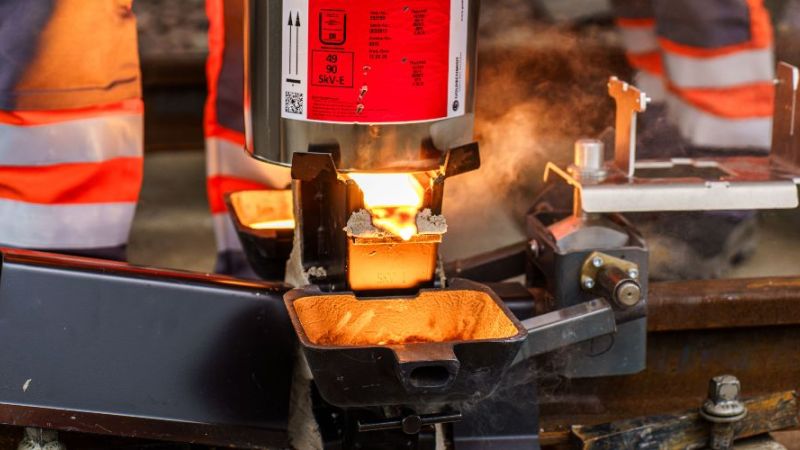
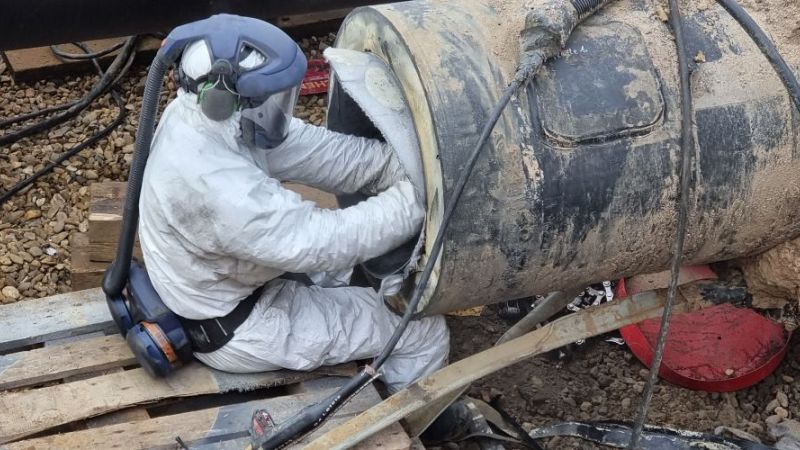
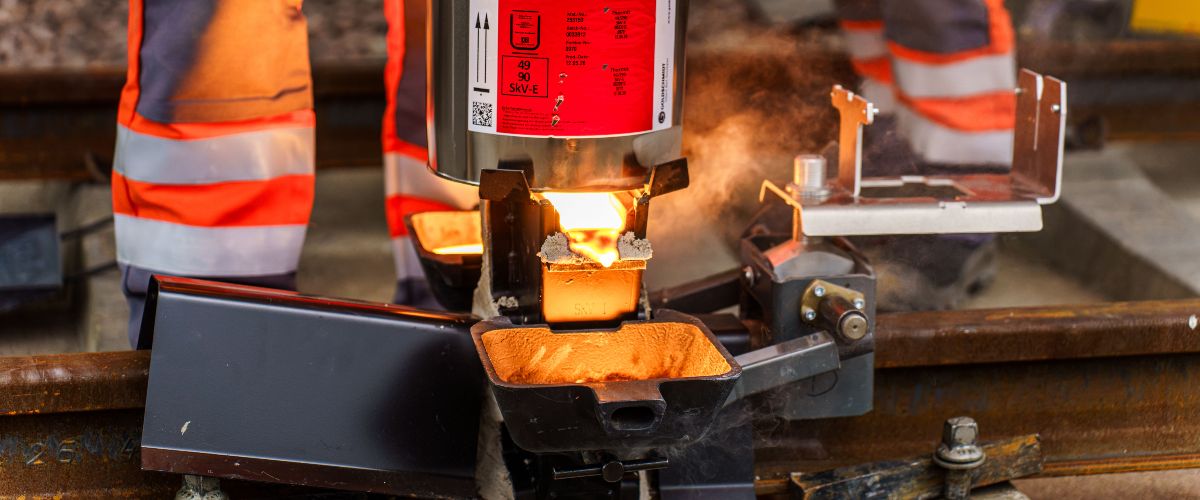
Aluminothermic (AT) welding is widely used around the world to maintain rails and repair damaged sections of track directly on site. In this thermochemical welding process, a mixture of iron oxide and aluminium is ignited, triggering an exothermic reaction that produces molten iron. Alloying elements are then added to produce a steel with the properties required for the particular rail grade. The superheated steel is poured into the gap between the rail ends, which is enclosed by a mould. The heat melts the ends of the rails, while the steel solidifies within the gap, creating a continuous metallurgical bond.
The process is particularly flexible, robust and cost-effective. As the welding can be carried out directly on the track without the need for extensive infrastructure, disruption is kept to a minimum and only short track closures are required.
Digital twin optimises processes from preheating to microstructure formation
However, the individual stages of aluminothermic welding are highly energy- and resource-intensive. The drying and preheating stage, for example, takes several minutes and requires fuel gas. Aluminium is also used as a reducing agentremoving oxygen from the iron oxides and forming aluminium oxide in the process.
“In the PROENOS project, we have developed a deeper scientific understanding of aluminothermic welding technology, enabling us to describe and quantify the interactions between the individual process stages in greater detail than before,” says project leader Dr Jan Hantusch of Elektro-Thermit, a global supplier of thermite welding technology. The findings from PROENOS have helped reduce energy and resource consumption without compromising the robustness of the aluminothermic welding process or its suitability for use on railway tracks.
The research team focused on the following sub-processes:
- Preheating and drying, including changeover
- THERMIT® reaction in the crucible, including alloying
- Flow of the molten metal from the crucible into the casting system
- Melting of the rail ends, followed by cooling and solidification
- Cooling and microstructure formation, including the establishment of the final thermomechanical stress state.
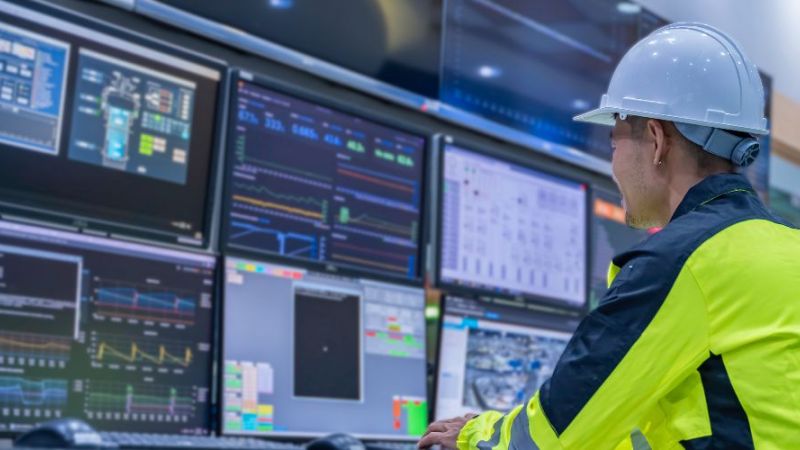
The project partners developed mathematical models of each stage and then combined them into an overall model that realistically represents the interactions throughout the process. The digital twin of aluminothermic welding can now be used to simulate different process variants quickly and in detail and predict their effects on weld quality.
40 percent lower energy consumption than standard welding processes
Building on these findings, the researchers further developed the aluminothermic welding process. The resulting process, known as Energy Efficient Welding (EEW), was advanced from Technology Readiness Level (TRL) 3 to TRL 5/6 over the course of the project. Compared with the standard SkV-Elite L25 and SoW-5 welding processes, the new process can reduce energy consumption by 40 percent. During preheating, energy consumption is reduced by 68 percent compared with the SoW-5 process or 40 percent compared with the SkV-Elite. For the Thermit® charge, the corresponding reductions are 20 percent and 40 percent respectively.
The energy savings during the preheating stage of the EEW process are achieved through inductive heating. This provides a continuous supply of energy from the start of the process until the Thermit® charge is poured. Because heat can be applied precisely where and when it is needed, the technology offers considerable potential for further optimisation. Further research is required, however, to make induction heating more cost-effective and suitable for on-site use.
Alloy requirements reduced by almost a third
Further savings can be made by reducing the amount of alloy required. “Adding the alloy later, directly in the mould, prevents the alloying elements from burning off during the Thermit® reaction. Positioning the alloy precisely within the mould. Also means that alloying occurs only where it is needed. As a resut, the same effect can be achieved using just 30 percent of the original amount of alloy,” says Dr Jan Hantusch.
The PROENOS project, which began in January 2023, will conclude in September 2026. The project partners are Elektro-Thermit GmbH & Co. KG, the TU Bergakademie Freiberg and the SZF Stahlzentrum Freiberg e.V.