 © STORAG ETZEL
Hydrogen core network infrastructure
Salt caverns as flexible hydrogen storage facilities
They are essential for storing crude oil and natural gas – in future, salt caverns will also be used to store hydrogen. Researchers are currently testing how to ensure optimal operation with the comparatively small gas molecules as part of the H2CAST Etzel pilot project in Lower Saxony.
 © STORAG ETZEL / DEEP.KBB
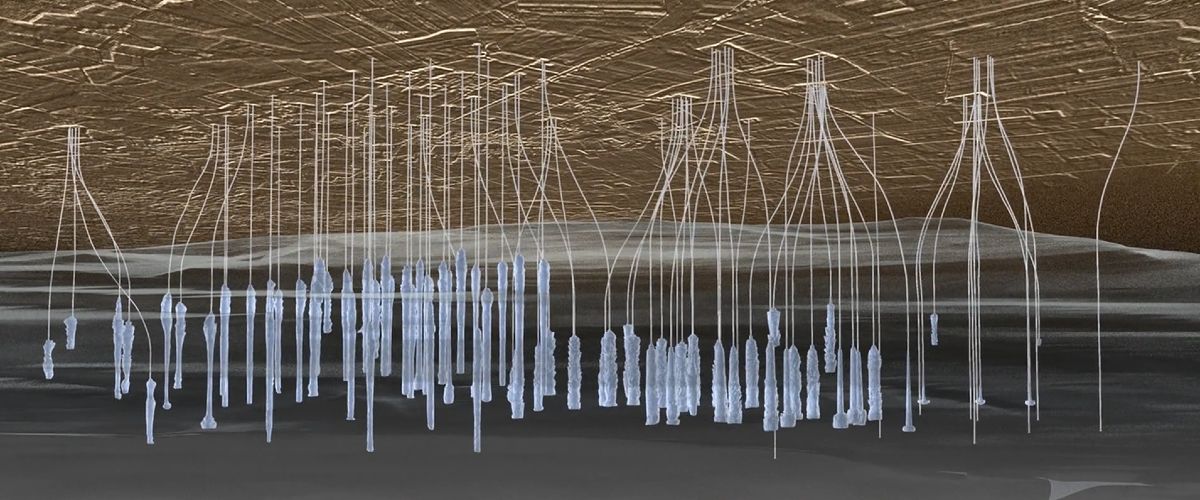
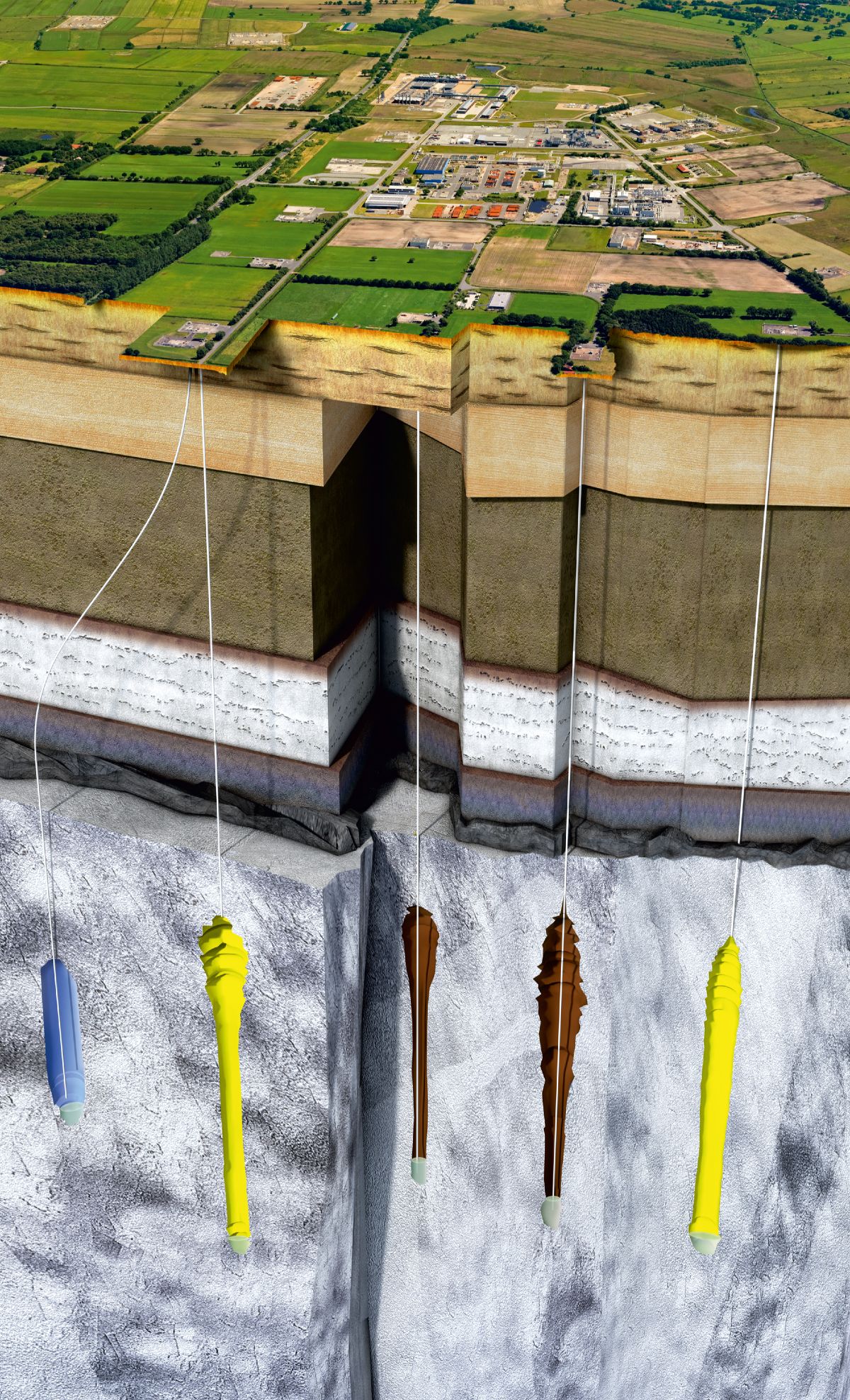
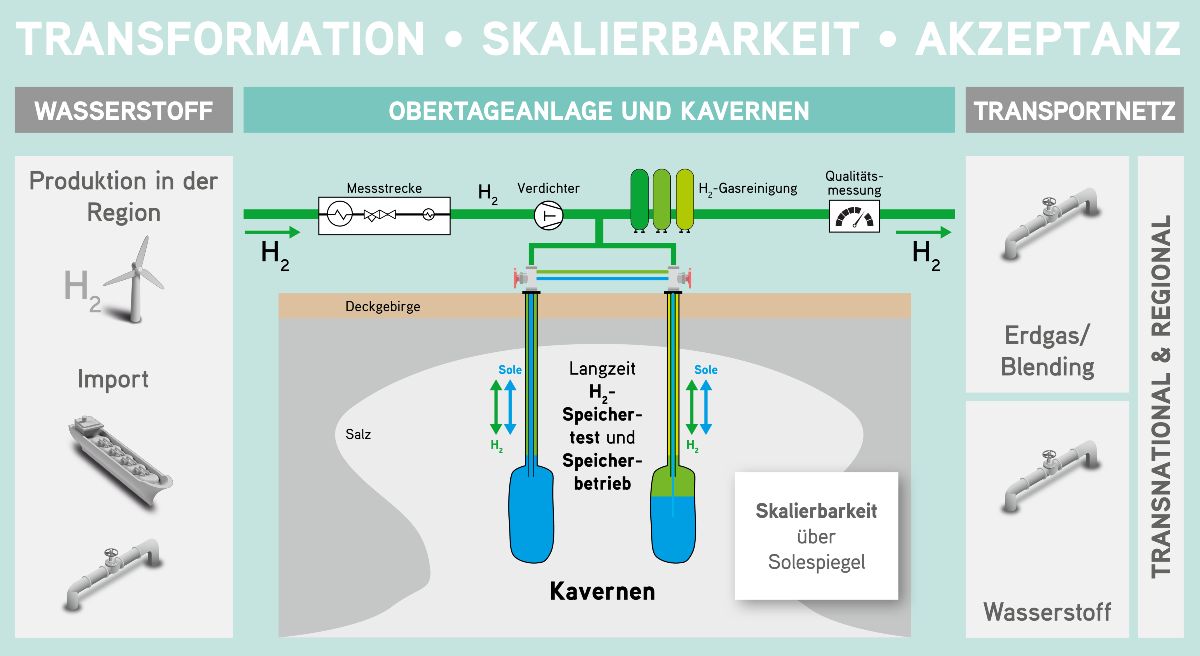
In March, the project team reached a milestone with the final fill-up of hydrogen: around 90 tonnes of the gas are now stored in two salt caverns at a pressure of 170 bar. Both were previously intended as storage facilities for crude oil or natural gas, as part of the 75 caverns currently in operation at the Etzel site. Caverns are artificially created, cylindrical cavities in salt rock at a depth of over 1,000 metres underground. The storage facilities used in the project have a volume of around 150,000 cubic metres and can be expanded to over 600,000 cubic metres.
Part of the large-scale H2CAST Etzel pilot project is the H2CAST ‘PROVE’ project. The project partners are developing various highly flexible and multicyclic operating modes on an industrial scale, which can be used to both store and release hydrogen. To this end, four specialist companies and two research institutions have formed a consortium, coordinated by STORAG ETZEL as the owner of the salt caverns.
Volume of stored gas volume flexibly adjustable
By dividing the system between two caverns, the team can test storage operations with charging and discharging cycles by diverting the gas from one cavern to the other – despite the (as yet) lack of connection to the nationwide hydrogen core network. The gas volume can be flexibly adjusted by displacing and pumping in the brine also present in the cavities. To this end, the project partners have installed an innovative system for socalled brine oscillation, which enables realistic operation in a closed loop. This ensures that the hydrogen volume is maintained without loss during the research work.
“In particular, we want to demonstrate that the existing facilities in the Etzel cavern field are suitable for hydrogen storage with substantially smaller H2 molecules without the need to develop new components. In addition to the retrofitting and operation of the underground storage facilities, the purification of the storage gas that comes into contact with brine and hydrocarbons is a key component of the research work,” says Carsten Reekers, head of the H2CAST joint project at STORAG ETZEL.
 © STORAG ETZEL
It has been proven that salt caverns are fundamentally suitable: “We have already demon-strated that the caverns are 100 per cent gas-tight with regards to hydrogen,” says project manager Reekers. The tightness and integrity of the two caverns are monitored continuously. The company plans to become a hub of the planned national hydrogen core network.
Researchers identify the most efficient method for purification and compression
The above-ground facilities are currently being completed. Here, the gas will be purified, compressed and its quality monitored before it is released for further use. As part of the PROVE research project, researchers are investigating various natural gas storage pro-cesses with regard to their functionality and efficiency. The methods used include gas dehydration by absorption (TEG), temperature swing adsorption on solids (TSA), as well as active filters and separators. The hydrogen composition is measured continuously after each purification stage using gas chromatograph controller for processing. “We want to identify the process that works most cost-effectively and reliably for hydrogen from converted caverns and determine the purification levels achieved. It is important to identify the technical and economic optimum,” says Reekers.
Decision-making framework for operators of salt caverns
The aim is to test and validate the highly flexible operating modes in the interaction between the underground and surface facilities under actual operating conditions. The results are intended to prepare for long-term operation of the cavern storage facilities. They should also be transferable to other sites. The researchers are also developing an overall system model that can be used to determine the respective design and the necessary operating parameters for comparable storage facilities. As part of the project, operators of salt caverns will receive a decision-making framework. Using that, they can assess the conversion of their infrastructure to the use of hydrogen. (mb)