 © reewungjunerr – stock.adobe.com
Security of supply and resilience
Research protects energy system from incidents and attacks
With the increasing share of renewable energies, the energy system is becoming more decentralized and requires adjustments to ensure a secure supply at all times. To make the energy supply resilient and future-proof, the Federal Ministry for Economic Affairs and Energy (BMWE) is promoting research that protects the system against attacks and failures.
Energy security is essential for the functioning of the economy and society, especially in highly developed countries such as Germany – but this also makes it a major target for attack. With the shift towards a decentralized energy system, the requirements for ensuring this security are changing. Due to the high proportion of locally generated electricity and heat using renewable energies, the system remains vulnerable in terms of technology and raw material imports, albeit different ones than in a fossil-dominated supply. At the same time, the system is becoming more susceptible to disruptions as it becomes more complex. Technology and resilience measures must therefore be able to respond quickly and effectively to external and internal events and keep the supply resilient and reliable. Solutions to this problem are also emerging from a wide range of research projects funded by the BMWE's 8th Energy Research Program.
 © Bundesnetzagentur
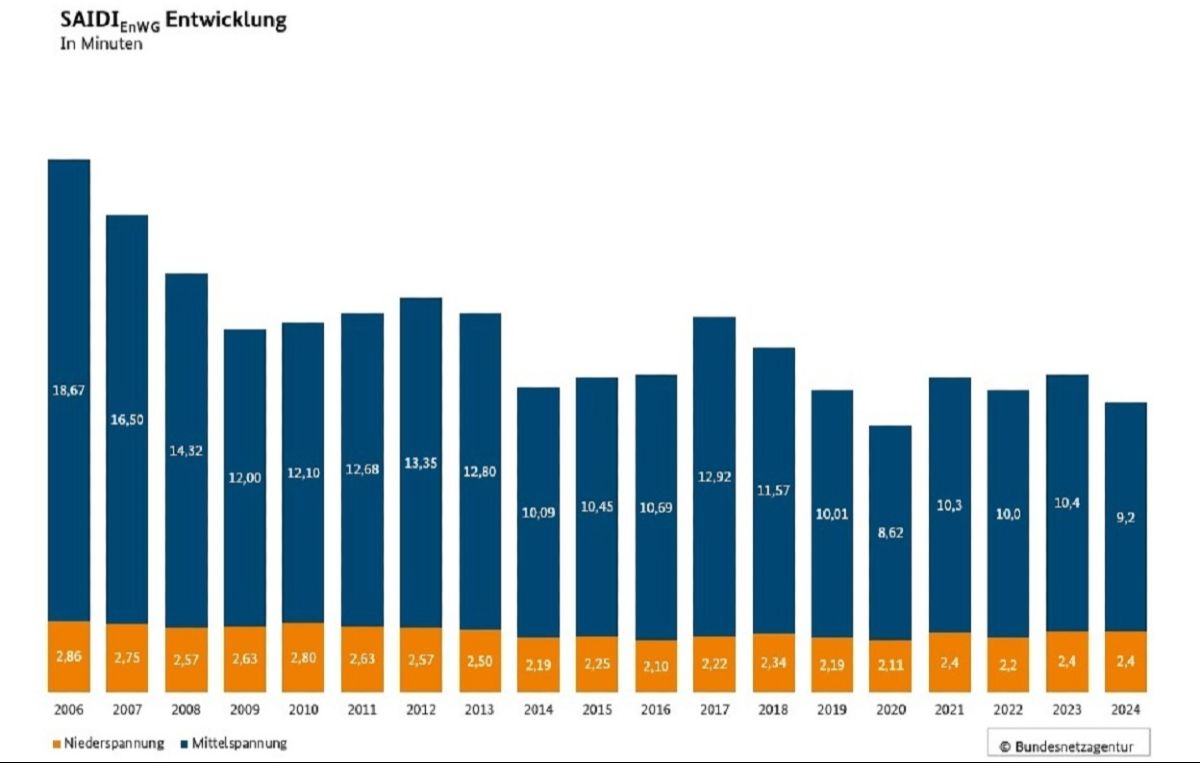
However, it is reassuring to know that power outages in Germany are fortunately rare and short-lived. The Federal Network Agency confirmed in October 2025 that the restructuring of the energy supply system towards greater decentralization and renewable energy will not lead to more or longer system failures. This is demonstrated by the gas supply, which had an average downtime of 1.52 minutes in 2024. In 2024, there were 164,645 supply interruptions in the low and medium voltage electricity supply. In 2010, this figure was still around 200,000. The average length of electricity outages per end consumer was 11.7 minutes in 2024. This figure has also improved over the last decade. This positive situation has been achieved not least through innovations that take account of the changed energy system.
Causes of power outages range from operating errors and technical faults to sabotage
There are many different causes of outages. Just under half are classified as other causes, such as incorrect operation of the power infrastructure or unexplained causes. According to the Federal Network Agency, the second most common cause is failures that fall within the remit of the network operators, such as cable or line faults. This is followed by third-party interference. This can include excavation work or traffic accidents, but also acts of sabotage and terrorist attacks. This also includes the large-scale power outage in Berlin in early 2026.
As a general rule, the frequency stability of the entire German power grid is guaranteed, as there are currently sufficient options available to maintain this stability at all times. In the European interconnected grid, this is achieved through instantaneous reserve and control power, among other things—so-called system services. This keeps the frequency stable within the normal range of between 49.80 and 50.20 hertz.
Project funding for energy security in the energy research program
Nevertheless, the transformation of the energy system is giving rise to new requirements, as a higher proportion of volatile renewable energy plants means that different solutions than before are needed to keep the system stable. For this reason, the BMWE is promoting research into security of supply and resilience in its 8th Energy Research Program as a specific program objective in the Energy System research mission. Funding here focuses on developing solutions for diversifying the energy system. Research to identify and reduce vulnerabilities in the energy system is also an area of focus. At the same time, approaches to reducing dependence on critical raw materials and strengthening technological sovereignty are to be investigated. However, the BMWE also funds projects that develop technologies for crisis prevention, preparedness, and management.
The research projects cover a wide range of topics, from overarching systemic approaches such as the RESILIENT project to very specific areas such as the cybersecurity of critical infrastructure, as in the KRITIS³M project. Some projects investigate resilience and security measures for specific technologies, such as S3dEL, which aims to develop a protection concept for decentralized electrolysis plants for hydrogen production. However, research into resilience and security of supply also includes projects such as ProRES. Here, a team is working with European partners to develop protection mechanisms for distribution networks using 100 percent renewable energy. The aim is to create the next generation of smart and resilient power grids that will continue to function reliably even in the event of extreme weather events, technical malfunctions, or cyberattacks.
 © RESILIENT team
Cross-sector planning tool for resilient energy infrastructure
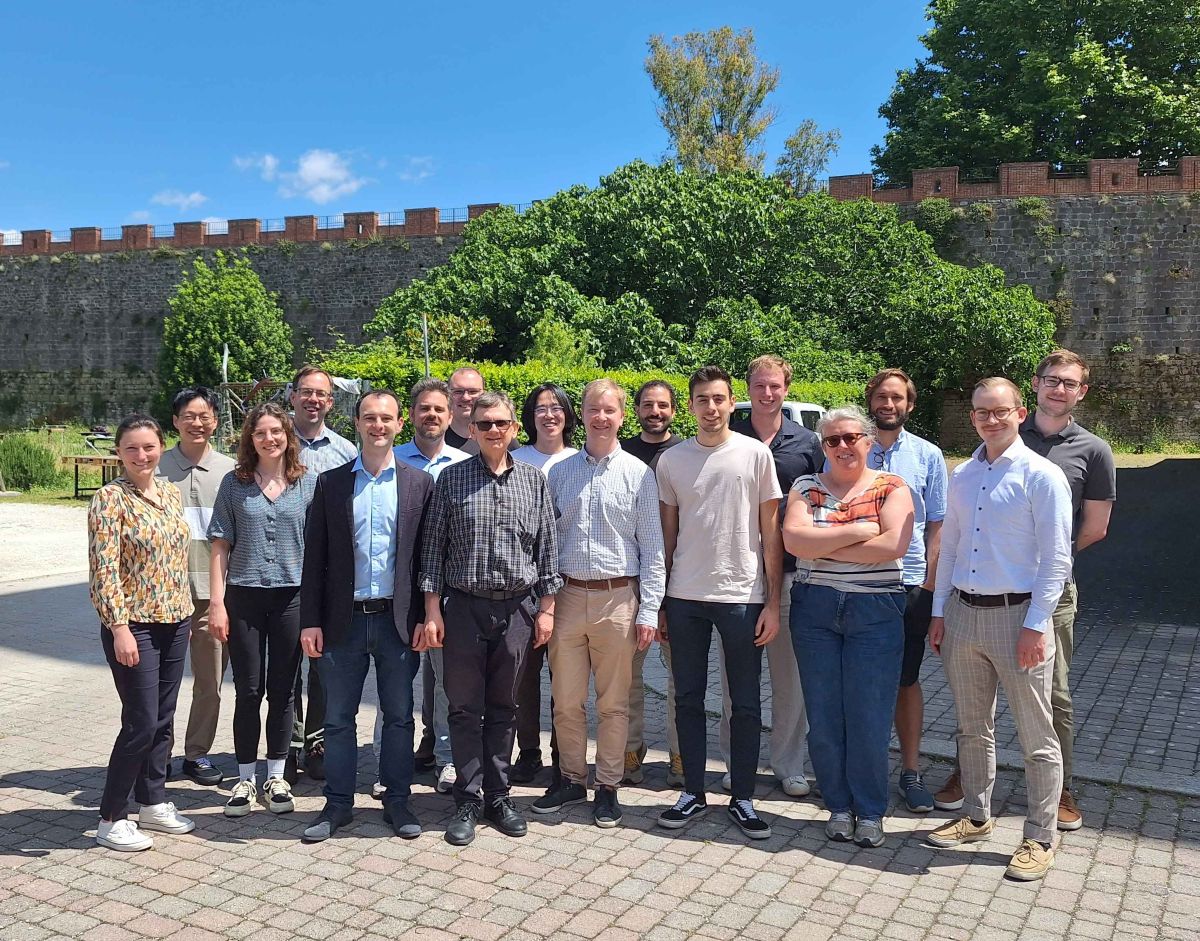
How can a robust and climate-neutral energy supply be reliably planned under conditions of uncertainty? The RESILIENT project is developing tools that place resilience at the heart of energy system planning. The basis for this is PyPSA-Eur, an open source energy system model for Europe that links electricity, heat, gas, hydrogen, and other sectors and displays them in high resolution.
The RESILIENT project integrates current challenges of the energy transition: cost risks, infrastructure expansion and delays, as well as acceptance issues – from the regional to the national and European level. The focus is on expanding PyPSA-Eur with new methods for taking uncertainties into account and improving the representation of industrial transformation and CO₂ infrastructure. The consortium's findings will be shared in leading journals and workshops with partners from research, industry, and the public. All improvements will be published as part of the open-source code base of the PyPSA ecosystem, allowing users worldwide to benefit from the project's work.
The project emerged from a call for proposals by the CETPartnership. Industry partners from France, Germany, Sweden, and Finland want to demonstrate the model's capabilities for planning a climate-neutral and resilient European energy system in several case studies.
Cybersecurity for energy and water supply through cryptography and artificial intelligence
In the KRITIS³M project, a research team is developing new approaches to cybersecurity. The aim of the project is to comprehensively secure digital communication in critical infrastructures (e.g., energy and water supply) – from the control room to the devices in the field, such as in substations or distribution stations. The main focus is on agile cryptography. These are long-lasting, adaptable cryptographic methods. The team is also taking modern fiber optics into account.
In addition, the project team wants to enable attack detection in the developed gateway demonstrators, for example in the communication path (alarm in case of an attack on the cable connections). Unauthorized modification of data packets and the replay of recorded data packets at a later point in time should be detected and trigger an alarm. Attacks should be detected and prevented at an early stage. In addition, KRITIS³M is conducting research into attack detection using artificial intelligence heuristics. Demonstrators are also being integrated into existing wide area networks as transparent security modules.
This creates a system that reliably identifies threats to cyber-physical systems and provides timely warnings in the event of vulnerabilities or attacks. Cyber-physical systems (CPS) are networks of physical components (machines, sensors, actuators) and information science software that communicate in real time via the Internet.
To achieve this, the system consistently encrypts data connections between the control center, gateways, and field devices, thus protecting them against manipulation. Different “performance classes” of security modules are designed to ensure that both powerful control center computers and smaller field devices receive suitable security components.
Because devices in energy and water supply are often in use for many years and quantum computers threaten classic encryption methods, the project team attaches great importance to “crypto agility.” This means that security procedures must be interchangeable and maintainable at the state of the art in cryptography.
Through this combination of strong encryption, flexible security modules, and intelligent attack detection, the KRITIS³M team aims to contribute to the stable and reliable operation of electricity and water networks in an increasingly digitized and vulnerable environment.
Innovations for protection against uncertainties, disruptions, and attacks
The transformation of the energy system requires more than just new and improved energy technologies. It requires an energy system that continues to function reliably despite uncertainties, disruptions, and attacks. Research projects under the 8th Energy Research Program provide key building blocks for this – from planning tools to cybersecurity. This ensures a robust, crisis-proof, and future-proof energy supply. (ml)